
Design of Experiments (DOE) is a structured, statistical approach to planning and analysing experiments to understand how multiple parameters simultaneously affect a measurable outcome (for example how temperature, incubation time and enzyme quantity may change DNA yield from a PCR reaction). Instead of changing one parameter at a time, DOE uses statistical modelling to create experimental designs to efficiently test systematically varied combinations (e.g. factorial designs). Through optimised experimentation, the main parameters which drive outcomes, which interactions parameters are dependent on one another/interact with each other, and optimal operating windows can be uncovered.
In chemical reactions that underpin next-generation sequencing (NGS), such as library prep enzymology, adapter ligation, PCR amplification and cleanup, DOE can optimise the workflow to reduce variability and improve yield. This in turn produces more consistent library preparation and fewer sample reruns, ultimately improving clinical confidence and lowering total cost per sample.
OFAT varies a single parameter while keeping others constant. It cannot detect interactions (for example, the effect of incubation temperature on enzyme amount) and is almost impossible to test comprehensively for complex processes such as NGS workflows. DOE varies multiple factors simultaneously in planned combinations to determine optimal parameters (such as reagent quantities and incubation times) and understand what other parameters affect this, which is critical for chemical reaction control.
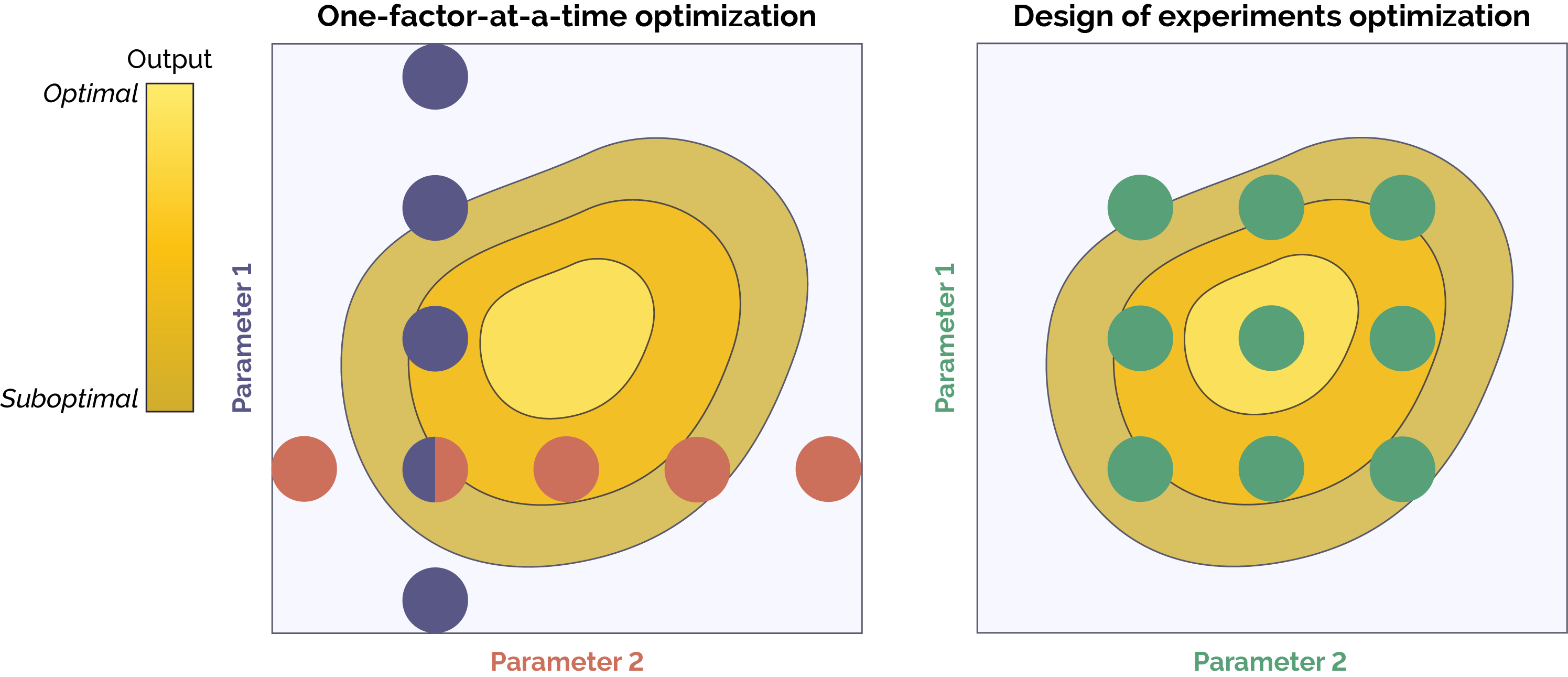
Figure 1: A representation of experiment design using OFAT and DOE and the resulting optimum output.
NGS workflows are complex with multiple steps that depend on prior outputs such as enzymatic reactions and cleanups (including fragmentation, end repair/A-tailing, adapter ligation, PCR amplification and bead-based size selection). DOE can be used to identify more complex novel interactions that affect these outputs and that cannot be identified with a traditional OFAT approach. These interactions, once captured, can then help to understand how to best balance outputs such as PCR yield, fragment size distribution and duplication rates. When balanced the resulting workflow benefits from more consistent outputs and QC metrics are far likelier to fall into acceptable ranges.
Common controllable factors for NGS workflows that can be investigated include enzyme concentration, reaction times, temperature, cleanup bead:sample ratio and wash conditions. Noise factors (parameters that are external to the workflow but may impact its performance, such as operator or ambient temperature) can also be analysed to verify robustness.
By setting parameters to levels where the process is less sensitive to noise, DOE directly reduces variance. That yields fewer borderline libraries, more consistent size distributions and higher first-pass QC, which shortens turnaround and lowers rework costs.
DOE models identify stable operating regions. That makes scale-up and automation easier, because parameters have tolerance bands compatible with high-throughput liquid handlers and varying batch sizes, meaning workflows are ready for increased sample amounts.
By analysing how different parameters in an NGS workflow interact in chemical reactions, DOE defines robust conditions that raise QC pass rates, reduce variation and lower cost per sample, all the while ensuring the utility of NGS products.
OGT is committed to continuous innovation and improving customer experience with our products. DOE optimisation has been applied to our Universal NGS Workflow Solution V2 to provide you with improved performance and robustness across different laboratory environments, so you can be confident of consistent workflow outputs.
→ View our range of SureSeq™ haematological malignancy NGS panels
Call +44 (0)1865 856800 Email contact@ogt.com
Send us a message and we will get back to you
 Visit USA site
 Visit Canada site