
Catarina Silva1, Sandra Kachhia1, Sophie Hortop1, James Reid1, Venu Pullabhatla1, Jacqueline Chan1, Graham Speight1
1Oxford Gene Technology, R&D, Cambridge, United Kingdom
Next-generation sequencing (NGS) has become routine in laboratories with many moving away from individual assays (e.g. FISH, PCR) to centralised NGS systems. This transition has increased sample throughput and highlighted the need for streamlined high performance workflows. Automation of NGS library preparation has become a key priority for laboratories seeking higher throughput, reduced hands‑on time, and improved reproducibility.
To address this, we have transferred and optimised Oxford Gene Technology’s (OGT) Universal NGS Workflow Solution V2 on the Hamilton NGS STAR MOA using OGT’s SureSeq™ Pan‑Myeloid Panel. This is a targeted assay covering 70 genes relevant to myeloid malignancies, including acute myeloid leukaemia, myelodysplastic syndrome and myeloproliferative neoplasms. It supports sensitive detection of SNVs and indels, with performance validated down to <5% variant allele frequencies (VAFs).
This study aims to demonstrate that OGT’s Automated Universal Workflow Solution using the Hamilton platform can deliver equivalent performance to established manual workflows while enabling the scalability and consistency required for high‑throughput myeloid genomics.
OGT’s Automated Universal NGS Workflow is an end to end automated version of OGT’s Universal Workflow (Figure 1).
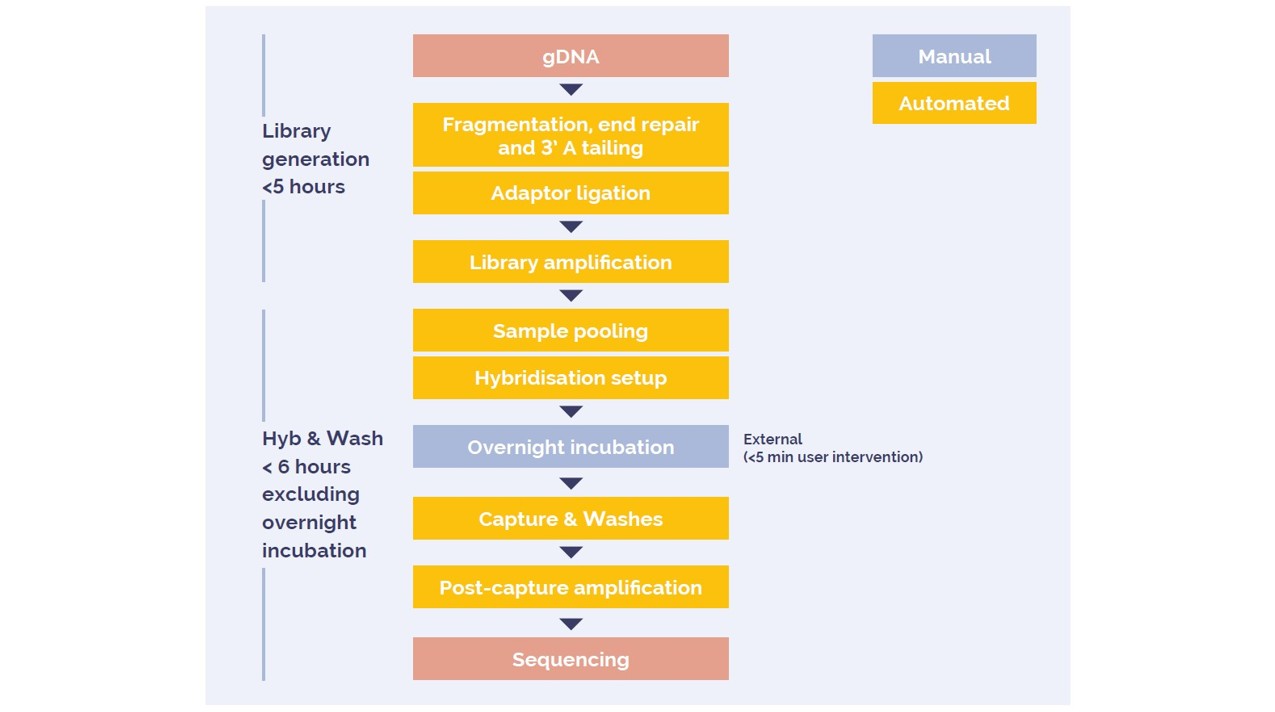
Figure 1: Overview of OGT’s Automated Universal NGS Workflow, an end-to-end solution with minimal user interventions.
The automation script was built on the Hamilton Microlab STAR VENUS 4.0.
The script is organised into two major methods - Library Preparation and Enrichment - each further divided into sub‑methods. This structure provides users with a high degree of flexibility enabling them to run either the full method or individual sub-methods (e.g. adapter ligation alone).
User selectable parameters, include DNA input, sample number (up to 96), and on or off deck thermal cycling, ensure compatibility with different instrument layouts and laboratory requirements.
Variant detection was evaluated using 500 ng of Mimix™ Myeloid Cancer Panel gDNA Reference Standard (Horizon Discovery Cambridge, UK) diluted to 1% VAF using NA12878 DNA (Coriell Institute for Medical Research, US). Human Genomic DNA (Promega, UK) was used to benchmark assay performance and sequencing reproducibility.
All libraries were prepared in batches of 48 or 96 samples and hybridised with OGT’s SureSeq Pan‑Myeloid Panel (770003). Sequencing was conducted using 2 x 150 bp reads on an NextSeq 1000 P1 XLEAP-SBS Reagent Kit (300 cycles) (Illumina, USA).
The automated workflow development involved rigorous liquid‑class optimisation. This focussed on key reagents whose viscosity, surface tension, or temperature sensitivity required fine‑tuned aspiration and dispense parameters; alongside liquid handling optimisation for optimal performance on the STAR platform. Strict version control was applied throughout, ensuring traceability across all iterations of the script.
The bioinformatics analysis was performed using Interpret NGS Analysis Software v3.9.22 (OGT) using the default Pan-Myeloid Panel protocol. This protocol enables the detection of SNV/Indels in addition to internal and partial tandem repeats.
The automated workflow can produce up to 96 libraries in under 5 hours, corresponding to a 500% increase in speed when compared to manual processing.
The automated workflow consistently generated high-yield libraries (>600 ng) across 48- and 96-sample runs (Figures 2A, 3A), with 14/16 runs achieving a 100% pass rate (yield >500 ng). While in development, intra-run variability was 8-12% for 48 samples, improving over time due to changes made to the script; and remained <9% for 96 samples (Figures 2B, 3B).
The automated library preparation demonstrated high reproducibility, with minimal intra- and inter-run variability while meeting yield specifications.
![<b>Figure 2.</b> Evaluation of <b>[A]</b> performance (yield) and <b>[B]</b> variability of the Library Prep Script with 48 samples across 8 independent runs.](/media/b3wdimy3/figure-2-evaluation-of-performance-yield-and-variability-of-the-library-prep-script-with-48-samples-across-8-independent-runs.jpg)
Figure 2. Evaluation of [A] performance (yield) and [B] variability of the Library Prep Script with 48 samples across 8 independent runs.
![<b>Figure 3.</b> Evaluation of <b>[A]</b> performance (yield) and <b>[B]</b> variability of the Library Prep Script with 96 samples across 8 independent runs.](/media/4nsfvsmk/figure-3-evaluation-of-performance-yield-and-variability-of-the-library-prep-script-with-96-samples-across-8-independent-runs.jpg)
Figure 3. Evaluation of [A] performance (yield) and [B] variability of the Library Prep Script with 96 samples across 8 independent runs.
Three verification runs (n=48 each) showed more consistently higher yields (865.6 ± 125.5 ng), comparable to manual workflow (760.8 ± 160.5 ng) with lower variability (CV 14.5% vs 21.1%).
Compared to manual processing, automated libraries were shorter (379 ± 10.2 bp vs 456 ± 9.70 bp) but demonstrated equivalent performance (data not shown) and improved consistency, with reduced intra- and inter-run variability. Enhanced reproducibility is attributed to reduced user-dependent variation and uniform high-throughput automated liquid handling.
![<b>Figure 4.</b> Comparison of <b>[A]</b> yield and <b>[B]</b> fragments length of the automation verification runs (1-3) with the manual workflow.](/media/h1fhqkm2/figure-4-comparison-of-yield-and-fragments-length-of-the-automation-verification-runs-1-3-with-the-manual-workflow.jpg)
Figure 4. Comparison of [A] yield and [B] fragments length of the automation verification runs (1-3) with the manual workflow.
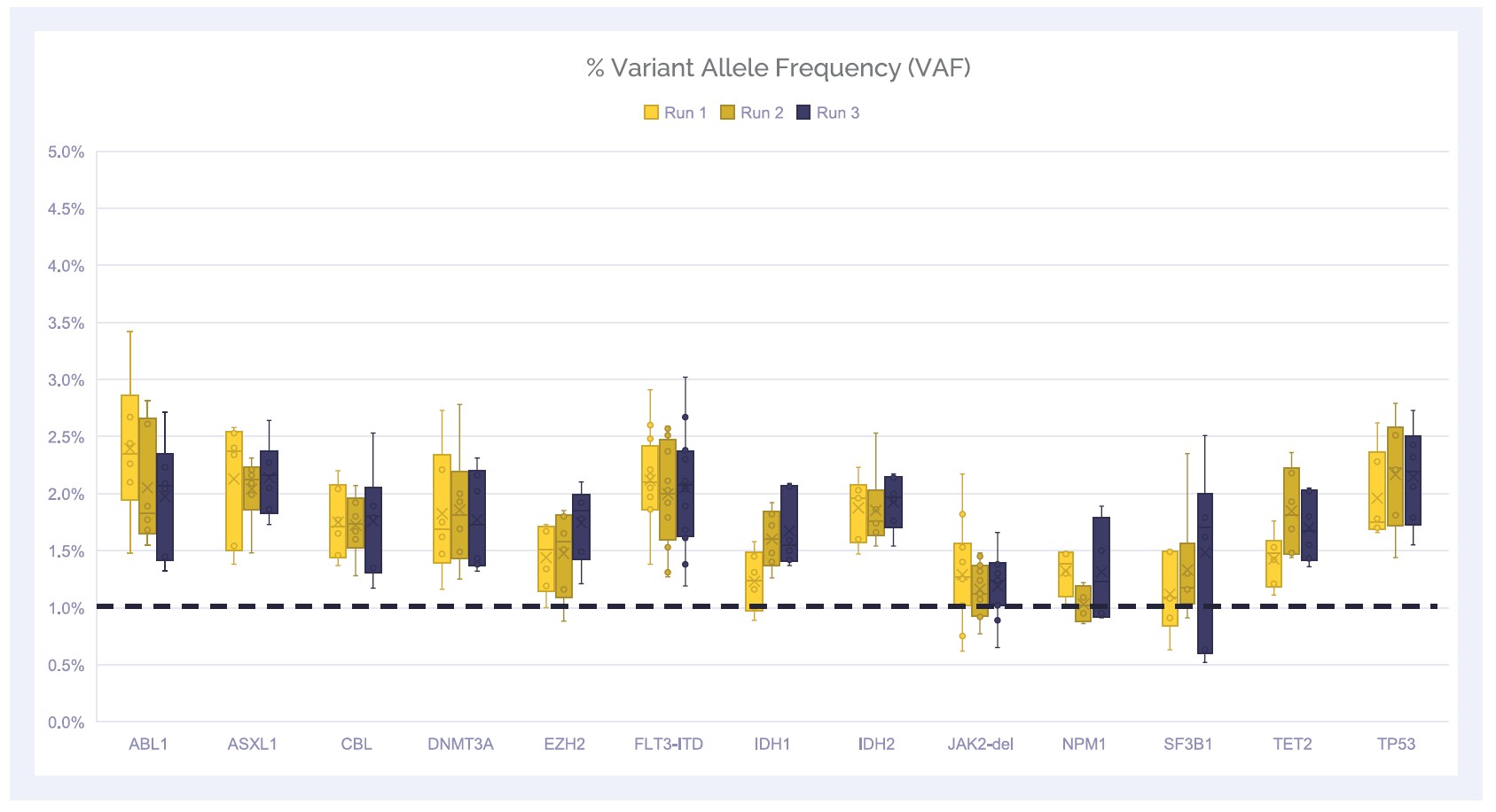
Figure 5. Detection of biomarkers present in OGT’s SureSeq Pan‑Myeloid Panel down to 1% VAF.
SureSeq: For Research Use Only; Not for Diagnostic Procedures.
Call +44 (0)1865 856800 Email contact@ogt.com
Send us a message and we will get back to you
 Visit USA site
 Visit Canada site